
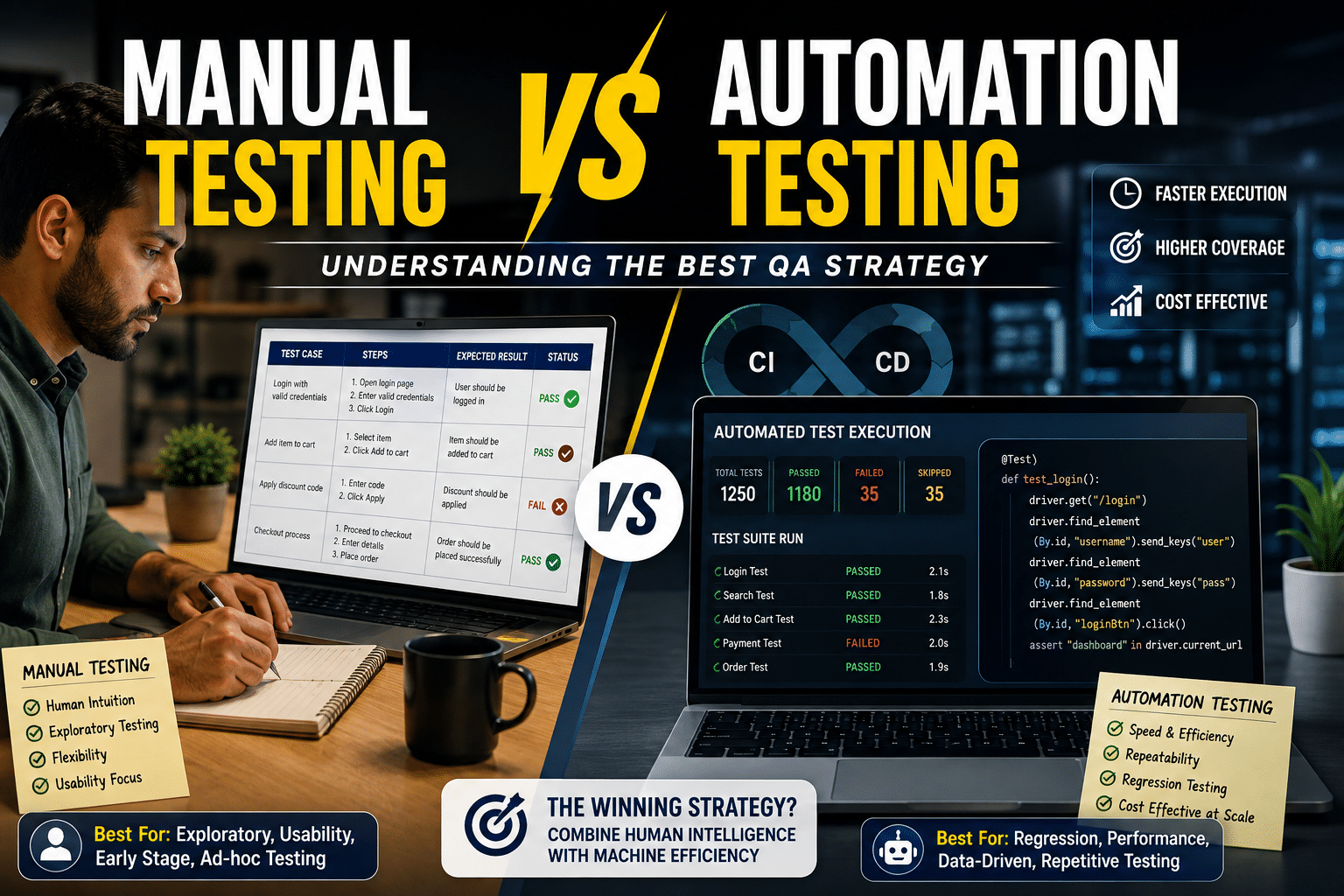
In the fast-paced landscape of modern software development, delivering features quickly is only half the battle. If your application ships with critical bugs, broken workflows, or security vulnerabilities, user trust evaporates overnight. Organizations face a perpetual balancing act: how to accelerate release velocity while simultaneously safeguarding uncompromised quality.
At the heart of this balancing act lies one of the most critical architectural decisions in quality assurance: Manual Testing versus Automation Testing.
Many teams fall into the trap of viewing this as a binary choice—believing they must choose one or the other to govern their software development lifecycle (SDLC). In reality, modern QA excellence is not about choosing a side; it is about orchestrating a strategic synergy between human intuition and machine efficiency.
At Brancea, we believe that true digital authority is built on robust, reliable, and meticulously tested software ecosystems. In this comprehensive, SEO-friendly guide, we will break down the fundamental differences between manual and automation testing, examine their respective strengths and limitations, and reveal how to build a high-ROI QA strategy that scales with your business.
The Modern Quality Landscape: Why Testing Strategy Matters
Software quality can make or break a digital enterprise. Whether you are running a high-traffic e-commerce platform, a mission-critical fintech application, or a scalable SaaS product, your users expect seamless performance across every browser, device, and operating system.
When engineering teams rush code to production without a structured testing framework, technical debt piles up. Fixing a bug in production costs exponentially more than catching it during the initial development phase.
To prevent costly post-release failures, organizations deploy two primary forms of execution: Manual Testing and Automation Testing. Understanding when, where, and how to apply each approach is the hallmark of a mature engineering culture.
Part 1: Deep Dive into Manual Testing
Manual testing is the traditional form of quality assurance where human testers execute test cases without the aid of automated scripts. Acting as the end-user, the QA engineer interacts with the software interface, fills out forms, clicks buttons, explores features, and observes system behavior to identify anomalies.
                         ┌─────────────────────────────┐
                         │       MANUAL TESTING        │
                         │    (Human-Driven Insight)   │
                         └──────────────┬──────────────┘
                                        │
        ┌───────────────────────────────┼───────────────────────────────┐
        ▼                               ▼                               ▼
┌───────────────┐               ┌───────────────┐               ┌───────────────┐
│  Exploratory  │               │   Usability   │               │  Ad-Hoc & UI  │
│    Testing    │               │  Assessment   │               │   Validation  │
└───────────────┘               └───────────────┘               └───────────────┘
The Unmatched Strengths of Manual Testing
-
Human Intuition and Adaptability: Human testers possess subjective judgment, empathy, and contextual awareness. They can instantly sense if an interface feels awkward, if a color scheme causes eye strain, or if a user journey feels counter-intuitive—nuances that lines of code cannot evaluate.
-
Exploratory Testing Excellence: In exploratory testing, the tester’s knowledge and creativity guide the process. Instead of following rigid pre-written scripts, engineers actively probe the system, hunt for unexpected edge cases, and simulate unpredictable user behavior.
-
Low Initial Setup Cost: Manual testing requires no upfront investment in test framework development, scripting languages, or complex CI/CD pipeline integrations. You need a test plan, a user interface, and skilled human testers.
-
Ideal for Early-Stage Products: When a product is in its infancy and wireframes or UI designs change daily, writing automated scripts is a waste of resources because the underlying locators and elements are constantly shifting. Manual testing provides the flexibility required during rapid prototyping.
The Inherent Limitations of Manual Testing
-
Time-Consuming Execution: Humans operate at human speed. Executing a comprehensive regression test suite of 500 test cases manually can take days or weeks, creating severe bottlenecks in agile deployment cycles.
-
Prone to Human Error: Repetitive manual tasks lead to fatigue. Testers can easily miss subtle visual bugs, misread logs, or skip steps under tight release pressure.
-
High Long-Term Cost at Scale: As a product grows and requires continuous regression testing across multiple software iterations, relying solely on manual labor becomes financially unsustainable.
Part 2: Deep Dive into Automation Testing
Automation testing involves using specialized software tools, frameworks, and scripts to execute predefined test cases without human intervention. Once written, automated test suites can be executed repeatedly—often in parallel—at lightning speed.
The Core Strengths of Automation Testing
-
Blazing Speed and Efficiency: Automated tests can execute thousands of complex scenarios in a fraction of the time it takes a human team. Tests can run overnight or trigger automatically every time a developer pushes new code to a repository.
-
Flawless Consistency and Repeatability: Computers do not get tired, distracted, or careless. An automated script executes every single step with absolute mathematical precision, eliminating human oversight errors.
-
High ROI for Regression Testing: When you have stable core features that need to be re-tested after every minor code update, automation shines. It slashes regression testing cycles from days to minutes.
-
Advanced Performance and Load Testing: Automated tools can simulate thousands of concurrent virtual users hitting your servers simultaneously—a feat that is physically impossible to achieve with manual testers.
The Limitations of Automation Testing
-
High Initial Investment: Building a robust test automation framework requires skilled automation engineers, framework architecture planning, and significant upfront scripting time before seeing a return.
-
Zero Intuition or Empathy: Automated scripts only check what they are programmed to check. They cannot tell you if an app “feels right,” if an animation looks glitchy to the human eye, or if a design is aesthetically pleasing.
-
High Maintenance Overhead: When UI elements, button IDs, or layout structures change during product updates, automated scripts often break. Maintaining test scripts requires ongoing developer attention.
Part 3: Head-to-Head Comparison Matrix
To design an optimal QA strategy, let’s compare manual and automation testing across critical operational dimensions:
| Evaluation Metric | Manual Testing | Automation Testing |
| Execution Speed | Slower (Limited by human pace) | Blazing Fast (Instant programmatic execution) |
| Initial Cost | Low (Minimal tooling required) | High (Framework setup & specialized engineering) |
| Long-Term Cost | Scales linearly with product growth (Expensive) | High initial cost, but low marginal cost at scale |
| Human Intuition | Exceptional (Empathy, UX, exploratory insight) | None (Strict binary pass/fail verification) |
| Best Suited For | UX design, exploratory, ad-hoc, & early-stage apps | Regression suites, load testing, & CI/CD pipelines |
Part 4: When to Use Manual vs. Automation Testing
Knowing when to apply each testing methodology is critical for optimizing your engineering budget and ensuring comprehensive test coverage.
When to Strictly Choose Manual Testing:
-
Exploratory Testing: When you want testers to creatively probe the software for unknown vulnerabilities and edge cases.
-
Usability and User Experience (UX) Testing: When evaluating how human users emotionally and physically interact with your product interface.
-
Ad-Hoc Testing: When there is no formal test plan and an engineer relies purely on intuition to spot defects.
-
Short-Term or One-Off Features: If a feature is being built for a temporary marketing campaign or a one-time event, automating tests for it makes little financial sense.
When to Strictly Choose Automation Testing:
-
Regression Testing: Whenever stable features must be repeatedly validated after every code commit or bug fix.
-
Repetitive Data-Driven Tests: When executing the same test steps across dozens of different data inputs (e.g., e-commerce checkout forms with various payment methods).
-
Performance, Load, and Stress Testing: When simulating high-volume concurrent user traffic to measure server response limits.
-
Continuous Integration / Continuous Deployment (CI/CD): When your development pipeline requires automated gatekeeping to block broken code from reaching production environments.
Part 5: The Hybrid QA Model: Achieving Testing Nirvana
The most successful engineering organizations do not treat manual and automation testing as competitors. Instead, they integrate them into a harmonious, hybrid QA ecosystem often visualized through the Test Automation Pyramid.
                           ┌─────────────────────────┐
                           │      MANUAL TESTING     │
                           │   (Exploratory & UX)    │
                           └───────────┬─────────────┘
                                       │
                           ┌───────────▼─────────────┐
                           │    AUTOMATED UI TESTS   │
                           │  (End-to-End Workflows) │
                           └───────────┬─────────────┘
                                       │
                           ┌───────────▼─────────────┐
                           │  AUTOMATED INTEGRATION  │
                           │    (API & Component)    │
                           └───────────┬─────────────┘
                                       │
                           ┌───────────▼─────────────┐
                           │     AUTOMATED UNIT      │
                           │  (Base Code Functions)  │
                           └─────────────────────────┘
-
The Base (Unit & Integration Tests – 70% Automated): Automated unit tests written by developers verify individual code components and basic logic instantly.
-
The Middle (Regression & API Tests – 20% Automated): Automated scripts handle recurring regression suites, API connectivity checks, and standard user flows.
-
The Peak (Exploratory & UX Testing – 10% Manual): Skilled human QA engineers focus entirely on high-value exploratory testing, usability assessments, and nuanced edge cases.
This balanced approach maximizes engineering velocity while preserving the irreplaceable value of human intuition.
How Brancea Builds Digital Authority Through Expert QA Strategy
At Brancea, we recognize that quality assurance is not a post-development checklist item—it is a fundamental driver of business growth and digital authority. We help organizations design tailored QA strategies that eliminate bottlenecks, secure data integrity, and elevate user experience.
When you partner with Brancea for software testing and QA, our methodology encompasses:
-
Comprehensive QA Audit: We analyze your existing software lifecycle, codebase stability, and release frequency to determine the optimal balance of manual and automated testing for your product.
-
Custom Test Automation Frameworks: We architect scalable, industry-standard automation pipelines (leveraging tools like Selenium, Cypress, Playwright, and Appium) integrated directly into your CI/CD workflow.
-
Rigorous Exploratory Manual Testing: Our expert QA engineers deploy rigorous manual testing protocols to uncover subtle UI/UX flaws, edge cases, and usability friction points.
-
Continuous Performance & Security Engineering: We simulate heavy user loads, audit security vulnerabilities, and ensure your platform scales effortlessly under pressure.
-
End-to-End Partnership: Brancea acts as your long-term digital growth partner, ensuring your software products remain robust, secure, and market-ready.
Conclusion: Quality is a Strategic Imperative
In the digital arena, your software is your brand storefront. Launching buggy, unverified applications damages customer trust, inflates support costs, and halts your growth trajectory.
Neither manual testing nor automation testing is a silver bullet on its own. Manual testing provides the human empathy and creative insight necessary to evaluate true user experience, while automation testing provides the speed, scale, and repeatability required for modern agile deployment.
By forging a strategic hybrid QA model, you optimize your engineering resources, accelerate your time-to-market, and build unshakeable digital authority.
Are you ready to elevate your software quality and transform your QA processes into a competitive advantage? Connect with Brancea today to discover how our custom software testing and development solutions can accelerate your business growth.