
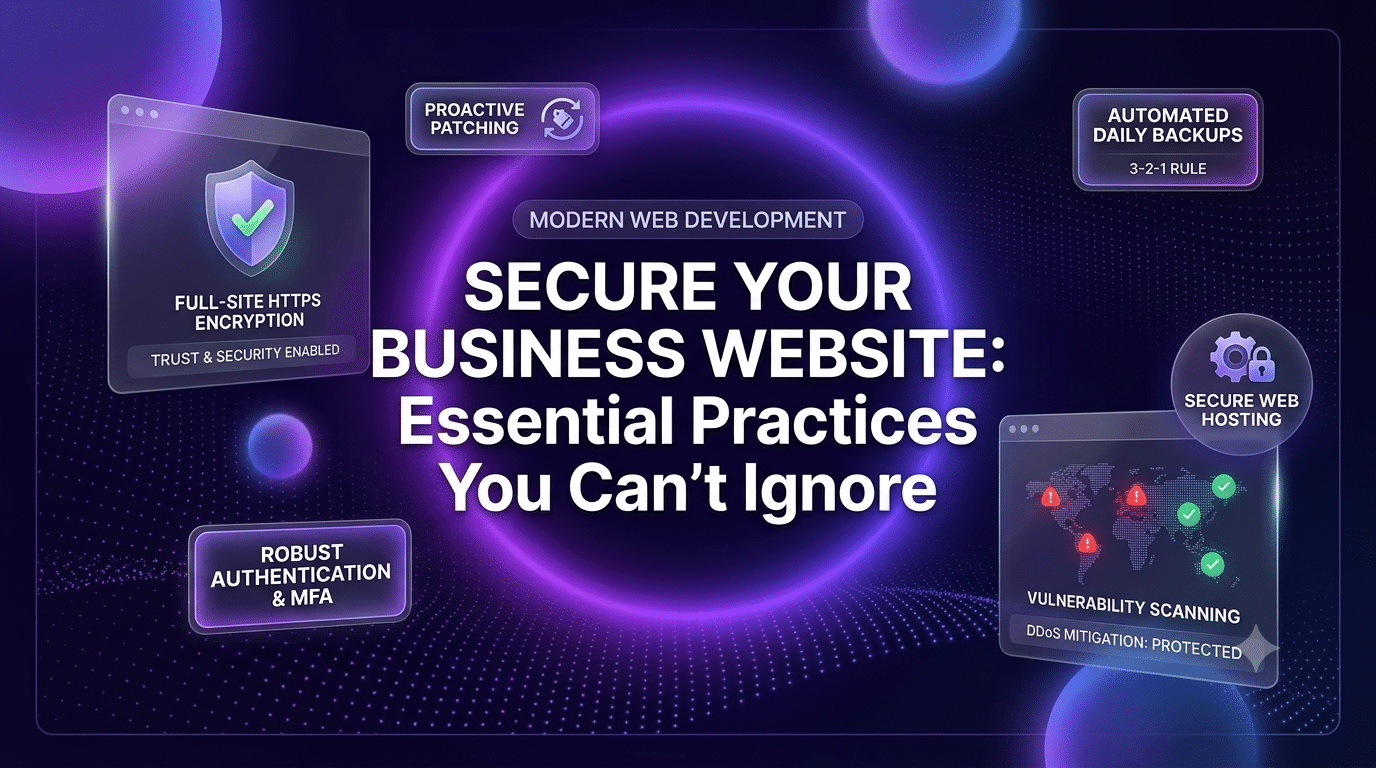
In the current digital age, a business website functions as the primary storefront, customer service hub, and revenue engine. Whether you operate a retail store in New York, a logistics company in Texas, or a growing software startup in California, your online presence is open to the world 24 hours a day, 7 days a week. However, this round-the-clock accessibility also exposes your enterprise to constant security threats from automated bots, malicious actors, and cybercriminals seeking vulnerabilities in your code.
When business owners think about web development, their primary focus is usually visual aesthetics, loading speed, and mobile responsiveness. While those elements are critical for user experience and search engine optimization (SEO), neglecting backend security can destroy your business overnight. A single data breach, compromised customer record, or malware injection can trigger catastrophic financial losses, steep legal penalties, and permanent reputational damage.
At Brancea, we specialize in building high-performance, secure digital platforms. In this comprehensive guide, we will explore why secure business website design is non-negotiable, examine the most critical security vulnerabilities facing modern sites, and break down the essential security practices every business website needs to stay protected.
The Rising Stakes of Website Security for Businesses
Cybersecurity is no longer a concern reserved exclusively for large multinational corporations and banking institutions. According to cybersecurity research reports, small and medium-sized businesses (SMBs) are targeted in nearly half of all cyberattacks because they often lack the hardened security infrastructure of enterprise organizations.
When a business website is breached, the fallout extends far beyond temporary downtime.
1. Severe Financial Loss
The financial toll of a cyber incident includes emergency developer fees, forensic investigations, ransom payments (if applicable), regulatory fines, and lost sales during downtime. For US businesses, a major data breach often runs into millions of dollars in total recovery costs.
2. Irreparable Reputational Damage
Trust is the hardest currency to earn in business and the easiest to lose. If your customers’ personal data, passwords, or credit card details are leaked due to poor website security, they will take their business to your competitors. Furthermore, search engines like Google will flag your site with warning screens, instantly tanking your organic traffic.
3. Legal and Regulatory Penalties
Depending on your industry and geographical reach, your business is bound by strict data privacy regulations such as the California Consumer Privacy Act (CCPA), the General Data Protection Regulation (GDPR) if you serve European clients, or industry-specific standards like HIPAA for healthcare providers. Failing to secure user data results in punishing government fines and lawsuits.
Core Pillars of Secure Business Website Design
Securing a website is not a one-time checklist item; it is an ongoing architectural philosophy that must be baked into every stage of the web development lifecycle. Below are the foundational security practices every modern business website requires.
1. Enforcing Full-Site SSL/TLS Encryption (HTTPS)
One of the most basic yet vital security standards is implementing an SSL (Secure Sockets Layer) / TLS certificate. An SSL certificate encrypts all data transmitted between your user’s web browser and your web server, making it impossible for hackers to intercept sensitive information like login credentials, credit card numbers, and contact form submissions.
-
Why It Matters: Beyond security, Google uses HTTPS as a positive ranking signal in its search algorithm. Sites lacking an SSL certificate are flagged by modern browsers like Chrome and Safari as “Not Secure,” causing immediate visitor drop-off.
-
Best Practice: Ensure your development team forces secure HTTPS connections across every single page of your domain using 301 redirects, rather than just on checkout or login pages.
2. Robust Authentication and Access Control
Weak administrative passwords and poorly managed user permissions are among the leading causes of unauthorized website takeovers. Hackers frequently use automated brute-force scripts to guess login credentials for content management systems (CMS) like WordPress, custom admin dashboards, and database portals.
-
Essential Practices:
-
Strong Password Policies: Require complex, high-entropy passwords combining uppercase letters, lowercase letters, numbers, and symbols for all administrative accounts.
-
Multi-Factor Authentication (MFA): Enforce MFA across all backend administrative logins. Even if a password is compromised, a secondary verification code sent to an authorized mobile device blocks unauthorized entry.
-
Role-Based Access Control (RBAC): Limit user permissions based on necessity. A content writer does not need full server or database administration privileges.
-
3. Rigorous Input Validation and Sanitization
The vast majority of web application vulnerabilities—including SQL Injection (SQLi) and Cross-Site Scripting (XSS)—occur because applications trust data submitted by users without properly vetting it.
-
SQL Injection (SQLi): Occurs when a malicious user injects malicious SQL statements into entry fields (such as search bars or login forms), allowing attackers to view, modify, or delete database contents.
-
Cross-Site Scripting (XSS): Allows attackers to inject client-side scripts into web pages viewed by other users, potentially stealing session cookies or redirecting traffic to malicious sites.
-
Best Practice: Implement strict input validation on both the client-side and server-side. Use parameterized queries, prepared statements, and automated escaping functions to ensure user inputs are treated strictly as data, never as executable code.
4. Keeping Software, Plugins, and Dependencies Updated
Most modern business websites rely on underlying frameworks, plugins, themes, and open-source libraries (such as PHP, Node.js packages, or WordPress components). When security researchers discover vulnerabilities in these components, they release patches. However, hackers actively scan the web for outdated software running unpatched vulnerabilities.
-
Best Practice: Establish a rigorous software maintenance schedule. Regularly update your CMS core, plugins, themes, and server software. At Brancea, we provide continuous maintenance plans to ensure our clients’ digital ecosystems are always patched against emerging threats.
5. Secure Web Hosting and Server Environment
Your website is only as secure as the server it lives on. Choosing a cheap, overcrowded shared hosting provider often means your site shares server resources with compromised websites, exposing you to cross-site contamination.
-
Best Practice: Invest in secure, high-performance cloud hosting (such as AWS, DigitalOcean, or managed enterprise hosting). Ensure your hosting provider offers proactive server monitoring, automated firewall protection, DDoS mitigation, and isolated container environments.
6. Automated Regular Backups and Disaster Recovery
No security posture is 100% impenetrable. Zero-day exploits, server hardware failures, or accidental human error can still cause data loss or site crashes. Having a reliable, automated backup strategy is your ultimate insurance policy.
-
Best Practice: Follow the 3-2-1 Backup Rule: Maintain at least 3 copies of your data, stored across 2 different media types, with at least 1 copy stored offsite or in immutable cloud storage. Configure automated daily or real-time backups, and regularly test your restoration process to ensure you can recover within minutes if disaster strikes.
Advanced Web Security Measures for Growing Enterprises
As your business scales and handles higher transaction volumes or sensitive proprietary data, standard security measures must be supplemented with advanced technical safeguards.
1. Web Application Firewall (WAF)
A WAF sits between your website visitors and your web server, acting as an intelligent reverse proxy. It inspects incoming HTTP/HTTPS traffic, filters out malicious botnets, blocks SQL injection attempts, and mitigates Distributed Denial of Service (DDoS) attacks before they ever reach your server infrastructure. Services like Cloudflare or Sucuri offer enterprise-grade WAF integration for modern websites.
2. Content Security Policy (CSP) Headers
A Content Security Policy is an HTTP response header that allows site operators to restrict the resources (such as JavaScript, CSS, Images) that the browser is allowed to load for a given page. Implementing a strict CSP header effectively neutralizes XSS and data injection attacks by telling the browser precisely which script domains are trusted.
3. Regular Vulnerability Scanning and Penetration Testing
Proactive security testing involves deliberately probing your website for weaknesses before malicious hackers find them. Automated vulnerability scanners check your codebase for outdated components, while professional penetration testing (ethical hacking) simulates real-world cyberattacks to uncover deep logic flaws in your web architecture.
Why Partnering with a Professional Web Development Agency Matters
Many business owners attempt to build and secure websites using cheap DIY site builders or offshore freelancers who cut corners on backend security to save time. This approach frequently results in bloated code, unpatched vulnerabilities, and zero ongoing support when things go wrong.
Partnering with an experienced digital agency like Brancea ensures your business website is engineered from the ground up for maximum security, speed, and conversion efficiency.
What Brancea Brings to Your Digital Infrastructure:
-
Custom Secure Coding Standards: We write clean, optimized, and secure code tailored specifically to your business requirements, avoiding bloated template vulnerabilities.
-
End-to-End Encryption & WAF Setup: We configure enterprise-grade SSL certificates, secure DNS records, and Web Application Firewalls to block malicious traffic.
-
Proactive Monitoring & Maintenance: We provide ongoing system updates, automated daily backups, and performance optimizations so you can focus entirely on running your business.
-
Holistic Digital Expertise: Beyond secure web development, Brancea delivers cross-platform mobile app development, rigorous QA software testing, SEO optimization, and high-ROI digital marketing strategies.
Conclusion: Secure Your Digital Foundation Today
Your business website is your most valuable digital asset. Leaving its security to chance is a risk no modern enterprise can afford to take. By investing in secure web development practices—such as full-site SSL encryption, robust authentication, input sanitization, regular software updates, and advanced firewall protection—you protect your brand, retain customer trust, and secure your long-term revenue growth.
Do not wait for a security breach to audit your digital infrastructure.
Ready to Build a Fast, Secure, and High-Converting Website?
Get in touch with our expert team at Brancea today. Let us handle the complex technical security engineering while you scale your business with absolute peace of mind!
📞 Contact Brancea: +91 8295230428 | ✉️ Email: brancea01@gmail.com | 🌐 Website: brancea.com
#WebDevelopment #SecureWebDesign #CyberSecurity #BusinessWebsite #BranceaDigital